Walk down any skincare aisle and the sheer choice of sunscreens is overwhelming. There are chemical and mineral filters, factor numbers from 15 to 100, star ratings, tints, gels, creams and sprays. Even worse, every one of them promises to be exactly what your skin needs. So how do you pick the best sunscreen for you? In this article, we’ll explore what actually matters when choosing a sunscreen and what you can safely ignore. We’ll also review how to pick the best sunscreen for your skin type and tone. We also cover best options for concerns like acne, rosacea and hyperpigmentation.
What Actually Matters When Choosing a Sunscreen?
In reality there are three things that absolutely matter when choosing a sunscreen and they’re non negotiable. These are the level of protection, the quality of the UVA cover and whether it’s a texture you’ll happily wear. This is what to look for on the label:
- SPF: This measures protection against UVB which is the wavelength that burns skin. You will find products with many different SPF values but the differences in coverage between SPF 30 and higher values is not huge. For example, SPF 30 filters around 97% of UVB and SPF 50 about 98%. However, most of us apply far less than the tested amount. That’s why it is better to opt for a higher factor to help compensate for that a little. For most people, SPF 30 is fine but if you’re prone to melasma, hyperpigmentation or sun spots, it is better to use SPF 50 or above.
- UVA star rating: UVA is the half of the label most people skip, and for your face it’s arguably the more important one. It’s present through all daylight hours, it reaches deeper into the skin and it drives wrinkles and fine lines as well as pigment. On UK bottles, the star rating runs up to 5 stars so the higher the better.
- The UVA circle: The letters UVA inside a circle mean the product meets the EU standard, with UVA protection at least a third of the labelled SPF. Broad spectrum simply means the product covers both UVB and UVA.
- Texture: A sunscreen only protects you whilst it’s on your skin, so the finish needs to be one you’re happy to wear every day.
Cancer Research UK advises using a minimum of SPF 30 with a 4 or 5 star UVA rating. Not only can it help with preventing photoageing, hyperpigmentation but it helps protect against a number of skin cancers. This includes melanoma where daily sunscreen use roughly halved the number of new melanomas over a decade in the only randomised trial to examine it. Sunscreen is also essential if you’re using actives like tretinoin or hydroquinone. These can make your skin more sensitive to the sun and reverse your gains
Should You Pick a Chemical or a Mineral Sunscreen?
Both chemical and mineral sunscreen protect skin equally well when you apply them properly. They’re both also safe for long-term every day use and come in a variety of formulations. So, which one to choose comes down to your skin and preferences.
Chemical sunscreens use organic filters that absorb UV radiation. Their light-weight and often invisible coverage make them the easiest to wear every day, especially under makeup and for skin of colour. Mineral sunscreens rely on zinc oxide and titanium dioxide to protect against UV light. Because these are chemically inert, they’re can be a great choice for sensitive, acne-prone or reactive skin as well as in pregnancy. Their trade-off is cosmetic, as classic mineral formulas can leave a white cast, particularly on deeper skin tones. Newer micronised formulas wear better and have a more invisible finish.
There are also a number of ingredients that can be added to these formulas to help with a number of skin concerns such as calm inflammation, even out skin tone and improve hydration. This includes things like centella, hydrators like glycerin or hyaluronic acid, Niacinamide and even Vitamin C. So the choice between chemical and mineral sunscreen really comes down to which one feels and looks better on your skin.
What’s the Best Sunscreen for Oily & Acne-Prone Skin
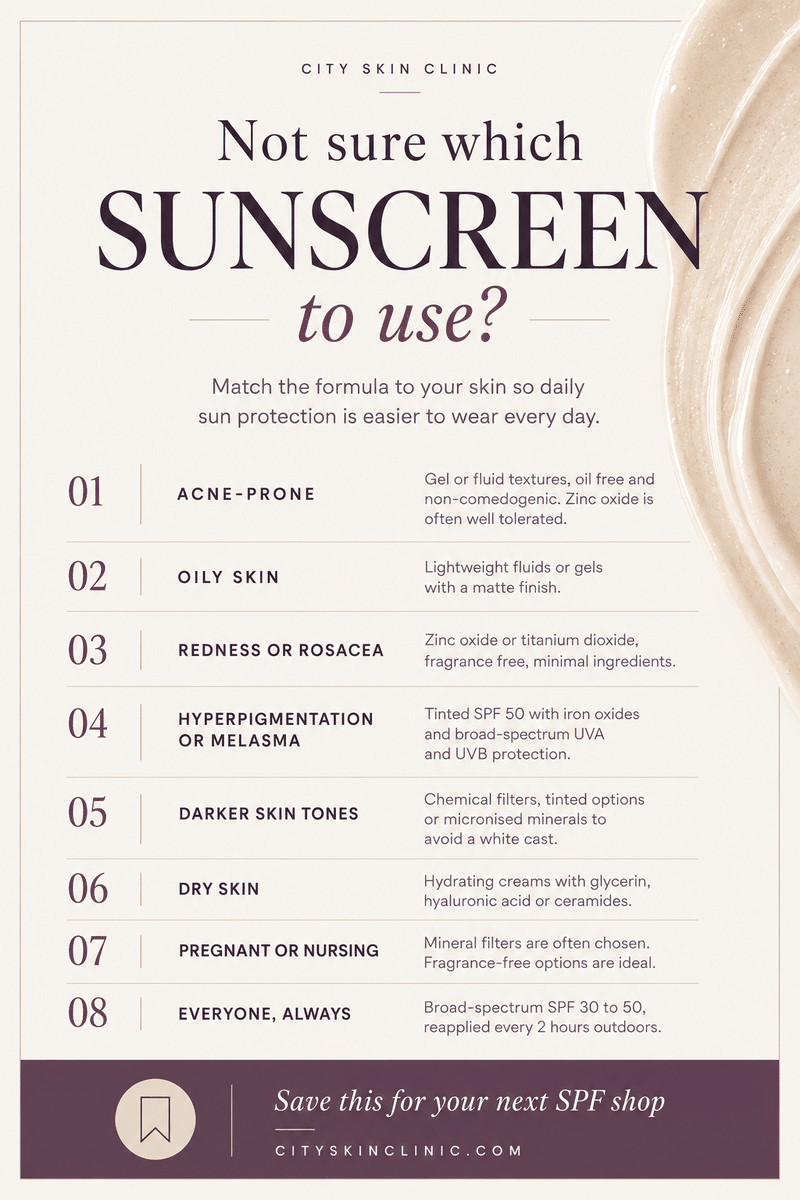
Oily and acne-prone skin does best with a lighter base, so reach for gels, fluids and water-based lotions instead of thick creams which can be comedogenic. If you have a lot of redness or inflammatory acne breakouts, mineral sunscreens containing zinc oxide may be better as they can help reduce oiliness and calm inflammation. Sunscreen will also help stop any post-inflammatory hyperpigmentation from acne from becoming darker.
How About if You Have Dry or Sensitive Skin?
For dry skin, a sunscreen in a moisturising cream base is your best bet. Look for formulas containing humectants like glycerin and hyaluronic acid on the ingredients list. Chemical sunscreen tend to have more moisturising formulas than mineral ones though increasing minerals are catching up.
For sensitive or reactive skin, including skin prone to rosacea or people who find chemical sunscreen stings their eyes, fragrance-free mineral formulas are usually best. This is because chemical filters can occasionally sting or irritate when the skin barrier is already compromised.
What is the Best Sunscreen for Darker Skin Tones?
Whilst melanin-rich skin is naturally more resistant to sunburn, it pigments much more easily and is still at risk of skin cancer. The best sunscreen for a deeper skin tone is one that disappears into it and doesn’t leave the dreaded grey-white cast. Traditional mineral formulas are the worst for this as they often don’t blend into darker skin tones. However, modern chemical sunscreens, hybrid formulas and tinted mineral ones are less likely to do this and look great on skin of colour.
Do You Need a Tinted Sunscreen for Melasma & Hyperpigmentation?
If you’re prone to melasma or recurring sunspots, then a tinted iron-oxide sunscreen may be the best option for you. This is because a standard sunscreen filters ultraviolet light but lets visible light pass straight through. Tinted sunscreens contain iron oxide which protect against visible light which is a driver of melasma. In a randomised trial, women using a tinted iron-oxide sunscreen had fewer melasma relapses than those using an untinted product with the same SPF.
Application Matters More Than the Sunscreen Itself
Whatever sunscreen you choose, how much you apply and how often you reapply is what ultimately matters. The difference between two good sunscreens is far smaller than the difference between proper and skimpy application. As a guide, adults need around 6 to 8 teaspoons (the size of a golf ball or shot glass) to cover the body. The face and neck alone need about two fingers worth (squeeze sunscreen onto the length of your index and middle finger). This is why the look and feel matters so much. If you like the product, you’re more likely to apply it generously and top up throughout the day. For a step-by-step guide on how to properly use sunscreen including timing and reapplying after swimming or sweating, checkout our introduction to sunscreen and sun protection.
| Skin type or concern | What to look for | Why it works |
|---|---|---|
| Oily or acne-prone | Oil-free gel or fluid, non-comedogenic | Light bases protect without blocking pores or adding shine |
| Dry | Cream base with vitamin E, glycerin, niacinamide or hyaluronic acid | Moisturising formulas protect and hydrate in one step |
| Sensitive or rosacea-prone | Fragrance-free, mineral formula with zinc oxide or titanium dioxide | Inert mineral filters rarely sting or trigger reactions |
| Darker skin tones | Modern chemical, hybrid or tinted mineral formula | Avoids the white cast whilst covering the visible light that drives uneven tone |
| Melasma & hyperpigmentation | Tinted iron-oxide sunscreen, SPF 50, highest UVA rating | Iron oxides block the visible light that standard SPF misses to which lower relapse |
| Pregnancy | Mineral formula | Zinc oxide and titanium dioxide are inert and gentle on delicate skin |
Regardless of your skin problems or even if you have no particular concern, the same principals apply. Use a broad-spectrum with at least SPF 30, that has 4 or 5 UVA stars and is in a texture you love. The best sunscreen is the one you’ll wear daily and reapply.
The best sunscreen isn’t the most expensive bottle or the biggest number on the shelf but a broad-spectrum SPF 30 or higher, with proper UVA cover, in a formula that suits your skin type and tone well enough that wearing it becomes automatic. Once you’ve found it, the most important thing is to apply it generously and consistently. However, it helps to remember that sunscreen prevents new damage rather than repairing what’s already there. If uneven tone, dark marks or melasma have already settled in, protection alone won’t necessarily fade them. For this, targeted skin treatments may be necessary alongside, of course, strict sun protection.
At City Skin Clinic, we are passionate about personalised skincare. Our online clinic offers topical prescription skincare treatments only, so we don’t sell or supply the sunscreens discussed but you can find them at most pharmacies and skincare shops. What our doctors can do is treat the hyperpigmentation, melasma and skin ageing that sun exposure drives, using prescription ingredients like tretinoin, tranexamic acid, azelaic acid and hydroquinone where appropriate. Book a virtual video consultation or use our online consultation form to get started. The journey towards great skin starts here.
This article is intended for general informational purposes only and is not a substitute for medical advice, diagnosis or treatment. Always consult a qualified medical provider for any medical concerns or questions you might have.


