Fixed drug eruptions are rarely talked about but make up about 8.4% of all adverse drug reactions. They are often mistaken for insect bites, eczema, contact dermatitis, bruising, herpes simplex or a burn. This is especially common when they affect the lips or genital area. However, unlike most rashes that spread widely and unpredictably, a fixed drug eruption often appears as one or more well-defined red, dusky or purple patches. Additionally, if you take the triggering medication again, the reaction can return and sometimes become more extensive. In this article, we’ll explore what fixed drug eruptions are, how they look and the medications most commonly linked to them. We’ll also review how to diagnose fixed drug reactions and what treatment usually involves.
What is a Fixed Drug Eruption?
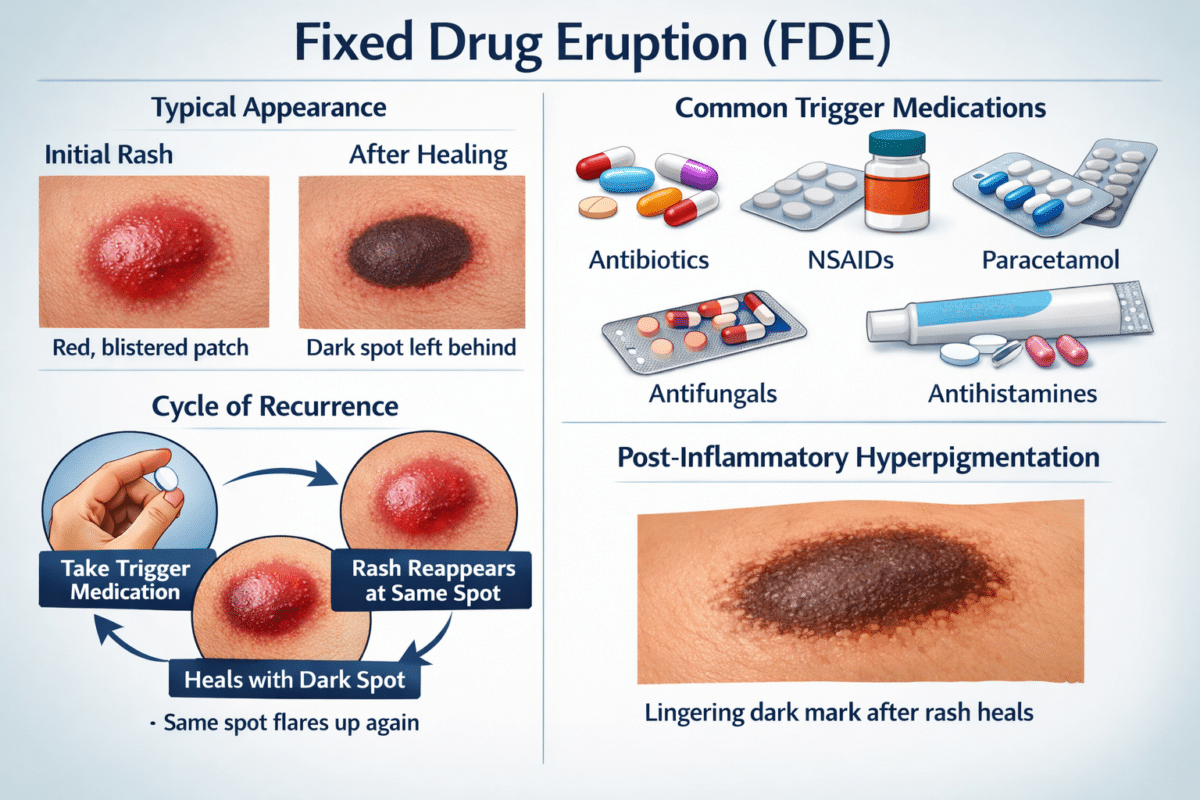
A fixed drug eruption (FDE) is a distinctive type of drug reaction that affects the skin. It typically develops after exposure to a medication and then recurs at the same site if you take that medication again. FDE is generally thought to be due to a delayed T-cell mediated allergic reaction. The first rash can appear hours to days after taking the offending drug. On re-exposure to the medication, the rash often comes back more quickly because the immune system has effectively “seen” the trigger before. Even when the inflammation settles, FDE often leaves behind lingering brown, grey or slate-coloured hyperpigmentation. In people prone to post-inflammatory hyperpigmentation or in deeper skin tones, dark marks may last significantly longer than the active rash itself.
What Does a Fixed Drug Eruption Look Like?
Classic fixed drug eruptions usually present as one or more round or oval, sharply defined patches or plaques. They often look red, dusky, violet or brown. These rashes may also become swollen, tender, itchy or give a burning sensation. Patches eventually develop a darker centre or blister. FDE can occur almost anywhere but common sites include the lips, genital area, hands, feet and trunk. Over time, the appearance tends to follow a pattern:
- A patch appears after taking the culprit drug
- It becomes inflamed, sometimes with blistering
- It settles over days to weeks
- A dark mark remains
- The same site flares again if you re-take the trigger, sometimes with new sites cropping up
Which Medications Commonly Cause Fixed Drug Eruptions?
A wide range of medications can trigger FDE, but some groups come up more often than others. Antimicrobials and non-steroidal anti-inflammatory drugs are two of the most common culprits. The most common medications to trigger fixed drug eruptions include:
- Antibiotics such as sulfonamides, tetracyclines, metronidazole, nitrofurantoin and dapsone
- Painkillers such as ibuprofen, naproxen and other NSAIDs
- Paracetamol
- Some antihistamines and antifungals
- Food additives or herbal products
How is a Fixed Drug Eruption Diagnosed?
A fixed drug eruption is the inflammatory reaction that initially presents as a rash. Post-inflammatory hyperpigmentation is the dark mark that stays behind after inflammation settles. However, patients usually present once the active redness has gone and only the hyperpigmentation remains. That is most likely if the initial rash was mild or short-lived. This tends to make initial diagnosis difficult since they might not connect the medication and rash with the hyperpigmentation. FDE is a clinical diagnosis. So, doctors usually rely on the history and the appearance of the lesions. The most useful details for your doctor to confirm diagnosis are:
- What the rash looked like
- Exactly when it appeared
- Every medication or supplement taken in the preceding days
- Whether something similar happened to the same site before
- If there are symptoms such as blistering, mouth involvement, fever or widespread skin pain
If the history is unclear, additional testing may sometimes help. Patch testing on previously affected skin can support the diagnosis in selected cases. It appears to be particularly useful for some NSAID-related FDEs. In some situations, a skin biopsy may also help support the diagnosis or exclude mimics. Doctors may also need to distinguish FDE from more serious cutaneous adverse drug reactions. That risk is highest when there is extensive blistering, erosions or systemic illness. That distinction is important because widespread bullous forms can overlap clinically with severe drug reactions such as Stevens-Johnson syndrome or toxic epidermal necrolysis.
How Do You Treat Fixed Drug Eruptions?
The most important treatment is stopping and then avoiding the triggering medication. If you identify the culprit drug and stop taking it, the active eruption usually settles by itself. In general there are two stages where treatment might help:
- Initial Rash Stage: Treatment for the rash is supportive and depends on severity. You can normally manage mild cases with a topical steroid to calm inflammation and itch alongside emollients to support barrier repair. More severe rashes may need stronger anti-inflammatory treatment and wound care if blistering is present. Regular medical review helps to reduce the risk of developing a more severe reaction or missing an alternative diagnosis.
- Hyperpigmentation Stage: Hyperpigmentation can linger after the active rash has gone. That is particularly frustrating when lesions occur on visible areas such as the lips, hands or face. It is also harder in patients with skin that pigments easily after inflammation. The key first step is preventing recurrence by avoiding the trigger. The mark itself usually fades on its own. However, pigment-fading topicals like hydroquinone may help speed this up once the skin is fully healed.
How Can You Prevent Another Episode?
Prevention depends on identifying and documenting the trigger properly. Once a medication is strongly suspected or confirmed, it should be recorded clearly in your medical notes. You should also communicate this to any clinician prescribing for you in future. These simple measures can help with diagnosis and prevent future fixed drug eruptions:
- Write a list of medicines taken before each flare
- Include over-the-counter tablets, supplements and combination cold/flu remedies
- Photograph the rash during an active episode
- Get a medical review as soon as you notice skin changes or any other adverse drug reactions
- Ask your doctor whether you need to avoid similar drugs in the same class
Fixed drug eruptions are usually localised and resolve by themselves once you stop the triggering medication. However, they can leave behind dark marks that persist for a long time. It’s important to get any skin or adverse drug reactions properly checked out by your medical provider. They will help you identify the trigger, prevent future episodes and provide treatment if needed.
At City Skin Clinic, we strongly believe that skincare is personal and should always centre around your needs. Our doctors provide custom topical skin treatments for post-inflammatory hyperpigmentation using ingredients like tretinoin, hydroquinone, azelaic acid, tranexamic acid and niacinamide where appropriate. If you would like a personalised skincare treatment please use our online skin consultation form or book a video consultation. Start your treatment journey today and take your first step towards great skin.
This article is intended for general informational purposes only and is not a substitute for medical advice, diagnosis or treatment. Always consult a qualified medical provider for any medical concerns or questions you might have.


